
Sauces & Condiments
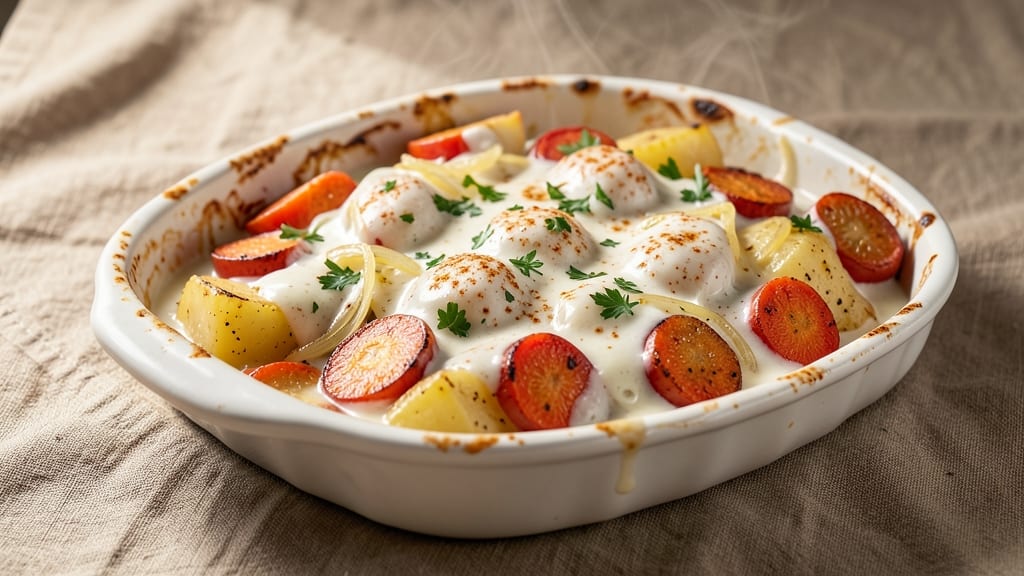
This baked veg in white sauce recipe transforms humble root vegetables into a luxurious side dish with crisp-tender edges and velvety herb cream. The secret lies in roasting vegetables until caramelized before baking them in a rich, velvety sauce that clings perfectly to each bite.
I developed this recipe after years of perfecting the balance between tender vegetables and a sauce that's neither too heavy nor too thin.
The foundation is a simple white sauce made with butter, flour, and milk, elevated with fresh herbs and a touch of Dijon mustard for depth.
What sets this dish apart is the two-step cooking process: first roasting the vegetables at high heat to develop natural sweetness, then finishing them in the oven with the sauce. This ensures vegetables stay crisp-tender while absorbing maximum flavor from the sauce.
By the time it emerges from the oven, you'll have a dish that's elegant enough for dinner parties but simple enough for weeknight meals. The vegetables maintain their natural texture while becoming infused with herby, creamy sauce that coats every bite.
The sauce's velvety texture pairs beautifully with the vegetables' caramelized edges, creating a harmonious balance of textures and flavors.
This recipe works as a satisfying side dish for meats or as a complete vegetarian main when served with crusty bread. The versatility makes it perfect for any occasion, from casual family dinners to more formal gatherings.
Here's how to create this restaurant-quality dish at home with minimal effort and maximum impact.
Ingredients for baked veg in white sauce
Root vegetables roasted to caramelized perfection paired with velvety herb-infused white sauce.
| Ingredient | Amount | Notes |
|---|---|---|
| Carrots 🥕 | 1 ½ lb | Medium-sized, cut into 1-inch chunks |
| Parsnips 🥕 | 1 lb | Peeled, cut into 1-inch chunks |
| Potatoes 🥔 | 1 ½ lb | Yukon Gold, cut into 1-inch chunks |
| Yellow Onion 🧅 | 1 whole | Cut into 1-inch chunks |
| Unsalted Butter 🧈 | ½ cup | Cold, cut into small cubes |
| All-Purpose Flour 🌾 | ½ cup | Sifted for smooth sauce |
| Whole Milk 🥛 | 2 cups | Full-fat for creaminess |
| Fresh Thyme Leaves 🌿 | ¼ cup | Chopped, stems removed |
| Fresh Parsley Leaves 🌿 | ¼ cup | Chopped, for garnish |
| Dijon Mustard 🍯 | 1 tbsp | For depth of flavor |
| Salt 🧂 | 1 tsp | Kosher or sea salt |
| Ground Black Pepper 🌶️ | ½ tsp | Freshly ground preferred |
| Garlic Cloves 🧄 | 3 cloves | Minced for sauce |
The vegetables are the heart of this dish, so choose firm, vibrant roots—organic carrots and parsnips from the produce section at Whole Foods or your local farmers' market work best. Yukon Gold potatoes add natural sweetness as they roast. For the best flavor, look for vegetables with smooth skins and no soft spots. If you can't find fresh thyme, dried thyme at one-third the amount will work in a pinch, though fresh is ideal for that bright herbal note. The key to crisp-tender edges is high-heat roasting before baking in the sauce.
No Dijon mustard? Regular yellow mustard at half the amount will add tang, though you'll lose some complexity. For a richer sauce, swap whole milk for half-and-half. If you're short on fresh herbs, dried parsley or basil at one-third the amount can substitute, though fresh is preferred. The garlic can be roasted with the vegetables for a sweeter flavor—simply toss the whole cloves with oil and roast alongside. For a gluten-free option, use cornstarch or arrowroot powder instead of flour to thicken the sauce.
Roasted vegetables keep well in the fridge for 3 days if stored in an airtight container. The white sauce can be made ahead and reheated gently—just add a splash of milk to loosen if it thickens. For best results, assemble the dish just before baking to maintain crisp-tender texture. Leftovers reheat beautifully in the oven at 350°F for 15-20 minutes, covered with foil to prevent drying. This dish freezes well for up to 2 months—just thaw overnight in the fridge before reheating.
Why You'll Love This Recipe
- One-Pan Magic: I swear by this—just toss everything on a sheet pan, drizzle with butter, and forget about it. No pots, no pans, no stress. That golden crust on the potatoes? Pure reward for doing nothing.
- Creamy Carrot Hug: The white sauce clings to those tender carrots like they’re long-lost friends. Sweet, buttery, and just enough tang to cut through the richness—it’s the kind of dish that makes you pause mid-bite and think, “Wait, is this actually healthy?”
- Lunchbox Hero: Between us, this is my go-to for meal prep. Reheats beautifully, keeps its texture, and even my picky teenager won’t swap it for store-bought “healthy” options. Pack it cold or warm—it’s always a win.
- Pantry Staple Power: Parsnips? Check. Potatoes? Always. Onion? Never runs out. This recipe turns ingredients you already own into something ridiculously satisfying. Honestly, I’ve made it on a budget so tight I used half the butter—and no one noticed.
Step-by-step instructions for baked vegetables in white sauce
This method delivers perfectly tender vegetables with a velvety sauce that clings beautifully.
👨🍳 Step 1: Prep and Parboil the Vegetables
Start by preheating your oven to 400°F. While it heats, prepare the vegetables according to the ingredients list - cut the 1.5 lb carrots, 1 lb parsnips, and 1.5 lb Yukon Gold potatoes into 1-inch chunks, and chop the 1 whole yellow onion into similar-sized pieces. This even sizing ensures everything cooks uniformly.
Bring a large pot of salted water to a boil and add the prepared vegetables. Parboil for 5-7 minutes until they're just tender when pierced with a knife - you want them to hold their shape but be slightly soft. Drain immediately and transfer to a large mixing bowl. This partial cooking prevents them from becoming mushy during the longer bake.
🔥 Step 2: Create the White Sauce Foundation
In a separate large skillet, melt the 0.5 cup unsalted butter over medium heat until it foams. Add the 0.5 cup sifted all-purpose flour all at once and whisk vigorously for 1-2 minutes until the mixture forms a smooth, pale roux. This is your sauce base - don't rush this step as it's crucial for preventing lumps.
Gradually whisk in the 2 cups whole milk over 2-3 minutes, ensuring each addition is fully incorporated before adding more. Stir in the 3 minced garlic cloves, 1 tbsp Dijon mustard, 1 tsp salt, and 0.5 tsp ground black pepper. The sauce should thicken noticeably as it simmers - it should coat the back of a spoon but still be pourable.
🥘 Step 3: Combine Vegetables and Sauce
Transfer the parboiled vegetables to a large, oven-safe baking dish. Pour the prepared white sauce over them, making sure each vegetable piece is well coated. The sauce should be enough to generously coat all surfaces but not create a pool at the bottom. Sprinkle the 0.25 cup chopped fresh thyme leaves evenly over the top.
Cover the baking dish tightly with aluminum foil and bake in the preheated 400°F oven for 30 minutes. This initial covered bake allows the vegetables to finish cooking gently while absorbing the sauce. The foil also helps prevent the sauce from drying out during this stage.
⏰ Step 4: Finish with Crisp-Tender Texture
Remove the foil and increase the oven temperature to 425°F. Return the dish to the oven and bake uncovered for an additional 15-20 minutes until the vegetables are fork-tender and the sauce has thickened to a glossy consistency. You'll see the edges of the vegetables develop a slight golden color - this indicates they're crisp-tender.
Before serving, sprinkle the 0.25 cup chopped fresh parsley leaves over the top. The parsley adds a bright finish that complements the rich sauce. Let the dish rest for 5 minutes before serving to allow the sauce to set slightly and the flavors to meld completely.
Pro Tips For Making Baked Veg In White Sauce
- PARBOIL POTATOES FIRST: I learned this the hard way—skipping the quick parboil means your potatoes turn to glue. Toss whole, unpeeled potatoes in boiling water for 8-10 minutes (yes, keep skins on for texture), then drain and rough up the edges with a knife. This guarantees even cooking and prevents a gummy center while the carrots and parsnips catch up.
- CUT ONIONS SMALL: I was skeptical until I tried it: tiny dice, not slices. A ½-inch yellow onion should end up as ⅛-inch cubes—this ensures it melts into the sauce instead of sitting as chewy chunks. Use a sharp knife and don’t rush; the extra prep time makes the sauce silky.
- BAKE AT 200°C (400°F) UNTIL GOLDEN: The oven’s too hot or too cool? Your veg will either burn or steam. Aim for 200°C (400°F) and bake until the edges of the potatoes are crisping and the carrots have caramelized spots—about 40-45 minutes. If the sauce looks dry, tent with foil for the last 10 minutes to keep it creamy.
- STIR IN COLD BUTTER: After baking, fold in 2 tablespoons of cold, cubed unsalted butter at the end—this isn’t just for flavor, it’s for shine. The cold butter coats the veg like a glossy finish and prevents the sauce from breaking. Skip the melted version; you’ll regret the greasy texture.
Essential equipment for this dish
Oven Essentials
You'll need an oven-safe baking dish that's at least 9x13 inches—I recommend a Ceramic CorningWare dish for even heat distribution. Preheat your oven to 400°F before starting, as this ensures consistent cooking. A digital meat thermometer helps verify vegetable doneness at 205°F internal temperature. 🌡️
Sauce-Making Tools
For the white sauce, a 10-inch heavy-bottomed skillet (like All-Clad) prevents scorching while making the roux. A whisk with a long handle ensures smooth incorporation of milk.
I also keep a fine-mesh strainer handy to remove any herb stems if needed. A wooden spoon works best for stirring without scratching nonstick surfaces.
Vegetable Prep Gear
Invest in a sharp chef's knife (I love Wüsthof) and a cutting board with a juicer groove to keep your workspace tidy. A mandoline slicer speeds up uniform cutting for potatoes and carrots.
For parboiling, a large stockpot with a lid and a slotted spoon make draining easy. Don't forget a colander for rinsing if needed.
Optional Upgrades
A laser thermometer (like Kizen) lets you check multiple vegetable pieces at once without opening the oven. For extra crispy edges, a pizza stone placed below the baking dish during the final 15 minutes at 425°F works wonders.
A microplane creates perfect garlic zest for garnish if you want to elevate presentation. 💡
Budget-Friendly Basics
If you're starting from scratch, prioritize a good baking sheet for roasting and a medium saucepan for the white sauce. A basic whisk and wooden spoon suffice for mixing.
For measuring, a stainless steel measuring cup set lasts longer than plastic. The key is maintaining cleanliness—hot pads protect your hands during transfers between hot surfaces.
Nutrition facts
Frequently asked questions
Can I use frozen vegetables in this recipe?
Fresh vegetables work best for that crisp-tender texture, but you can use frozen if needed. Thaw and drain them completely first, then pat dry with a paper towel. Add 2-3 extra minutes to the parboiling time since frozen veggies start colder. For best results, choose frozen vegetables with no added sauces or preservatives.
How can I make this dish gluten-free?
Swap the all-purpose flour for cornstarch or arrowroot powder—use the same 0.5 cup measurement. For thickening, whisk in 1 tablespoon at a time with the milk until the sauce reaches your desired consistency. The texture will be slightly lighter but equally delicious!
Why does my sauce get lumpy when making the roux?
Lumpy roux happens when flour clumps aren't fully incorporated. Always whisk vigorously for 1-2 minutes over medium heat until smooth and pale. For extra insurance, mix the flour with a bit of cold milk first before adding to the butter. This creates a "slurry" that blends seamlessly.
Can I prepare this ahead of time?
Make the sauce up to 2 days ahead and store it in the fridge. Reheat gently with a splash of milk if it thickens. For the vegetables, parboil and store them in an airtight container for 3 days. Assemble and bake just before serving to maintain crisp-tender texture.
What other vegetables work well in this recipe?
Try adding cauliflower florets, turnips, or butternut squash for variety. For heartier dishes, include celery root or rutabaga. Just adjust cooking times—denser veggies may need 5-10 extra minutes in the oven. Keep total vegetable volume similar to the original recipe for balanced flavor.